
I grew up in a small, beaten-down Massachusetts mill town, where nobody seemed particularly interested in anything beyond the town line, let alone tearing up their roots and wandering the planet.
Whatever strange defect or blessing I was born with, it made me want to snap those chains, to move light and fast, and now to slip from one corner of the globe to another like it’s the most natural thing in the world.
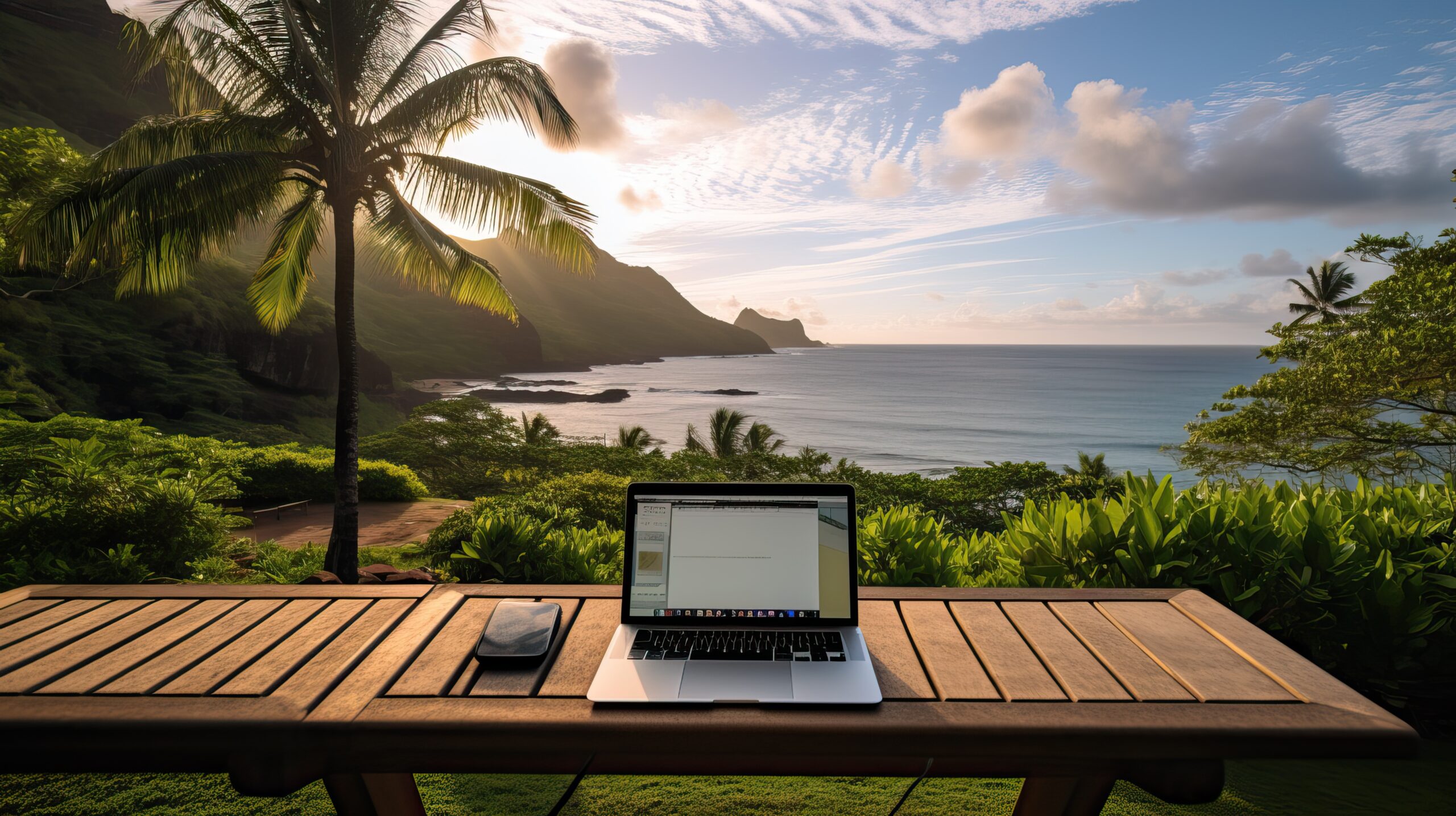
It used to be that the journey was the dream — not the life. You worked to escape, to afford the ticket out. The fantasy was a six-week vacation, a one-way flight into a life you’d eventually have to leave behind. But now the travelers have hacked the system. The road has become the office. The Wi-Fi signal is the leash — and the passport stamp, the reward for its endurance.
The pandemic showed us a dirty little secret — a lot of people don’t need to clock in somewhere to do their jobs. But here we are again, being herded back into the fluorescent-lit feedlot, because control makes the higher-ups feel safe. The old routine — hours lost in traffic, staring into screens under buzzing lights, pretending proximity equals productivity — it’s a kind of madness, a ritual sacrifice to the gods of middle management. And the cost of warehousing employees? $10k per employee per year in my Silicon Valley. Do the math.

Cafés are the new cubicles. You can spot us in every hemisphere — hunched over laptops in Lisbon, Chiang Mai, Oaxaca, or Medellín, performing the bloodless rituals of productivity with a flat white sweating nearby. We look like pilgrims and seekers in equal measure: digital monks trying to code, write, sell, or consult our way into meaning. There’s something beautiful about it — and something a little hollow, too.
Everywhere you go now, there’s a common dialect: Slack, Stripe, AirPods, VPNs. The lingua franca of the untethered. But talk long enough to anyone — the designer in Porto, the copywriter in Bali, the videographer in Mexico City — and you’ll feel the same itch under the conversation, the question humming between us: What now? Where next?
There’s something intoxicating about the freedom, even if it burns a little on the way down. Maybe the old idea of “home” was overrated anyway. Maybe what matters is the table — wherever you find it — the people you share it with, and the stories that keep you hungry enough to keep moving.
Because in this strange new banquet of work and wandering, the Wi-Fi might drop, the flight might cancel, and the calendar might overflow — but breaking bread, at least, should always be sacred. And if you’ve built your life well enough, that dinner can happen anywhere.
All the infrastructure is already there to make being a citizen of the world feel less like a manifesto and more like a default setting. Remote work visas have turned borders into negotiable suggestions, eSIMs let you drag-and-drop your life from Lisbon to Oaxaca overnight, and there’s always a co-working space with fast Wi-Fi, cold brew, and some kid from Berlin building an app you’ll never use.
Your bank lives in the cloud, your clients are scattered across time zones, and your “office” is whatever table has a power outlet and won’t kick you out for ordering one coffee and overstaying your welcome. The dream that used to belong to rock stars and trust-fund exiles — drifting from country to country, staying just long enough to pick up the local hangover cure and a bad tattoo — is now available to anyone with a laptop, a half-decent skill set, and the stomach to live out of a 40-liter bag.
We are, whether we’re ready for it or not, exactly what the old philosophers and the worst airline ads promised: citizens of the world, plugged in everywhere and belonging nowhere, chasing a signal strong enough to send the next file and a moment quiet enough to remember why we ever logged on in the first place.
A digital nomad life is worth considering now because work has finally uncoupled from place at scale, while the infrastructure, visas, and cultural acceptance to live “anywhere” have quietly snapped into place. For someone who already builds a life around writing, food, and movement, it is less a fantasy and more a realistic operating system for the next decade.
Work is no longer place-bound
The lifestyle is getting smarter
Governments are rolling out a welcome mat
Quality of life upside
Pulling the trigger