
What can I say about Rio de Janeiro, except more please. Immediately upon touching down in Copacabana a circuit breaker is hit. You’re instantly in the game. You don’t need to go to a party, it comes to you.
On a side street off Ipanema, an impromptu festinha breaks out, speakers rattle in a window, and a knot of women starts to move in that easy, offhand way Cariocas have, like they were born already in time with the bass line.
The women are barefoot or in cheap sandals, sequins fighting for real estate with sweat, laughing like they know something you don’t and never will. Hips mark out the rhythm with ruthless precision, shoulders roll, hair whips in the hot wind, and nobody is posing for the camera because the only audience that matters is the battered sky over Rio and whatever saints are on duty tonight.
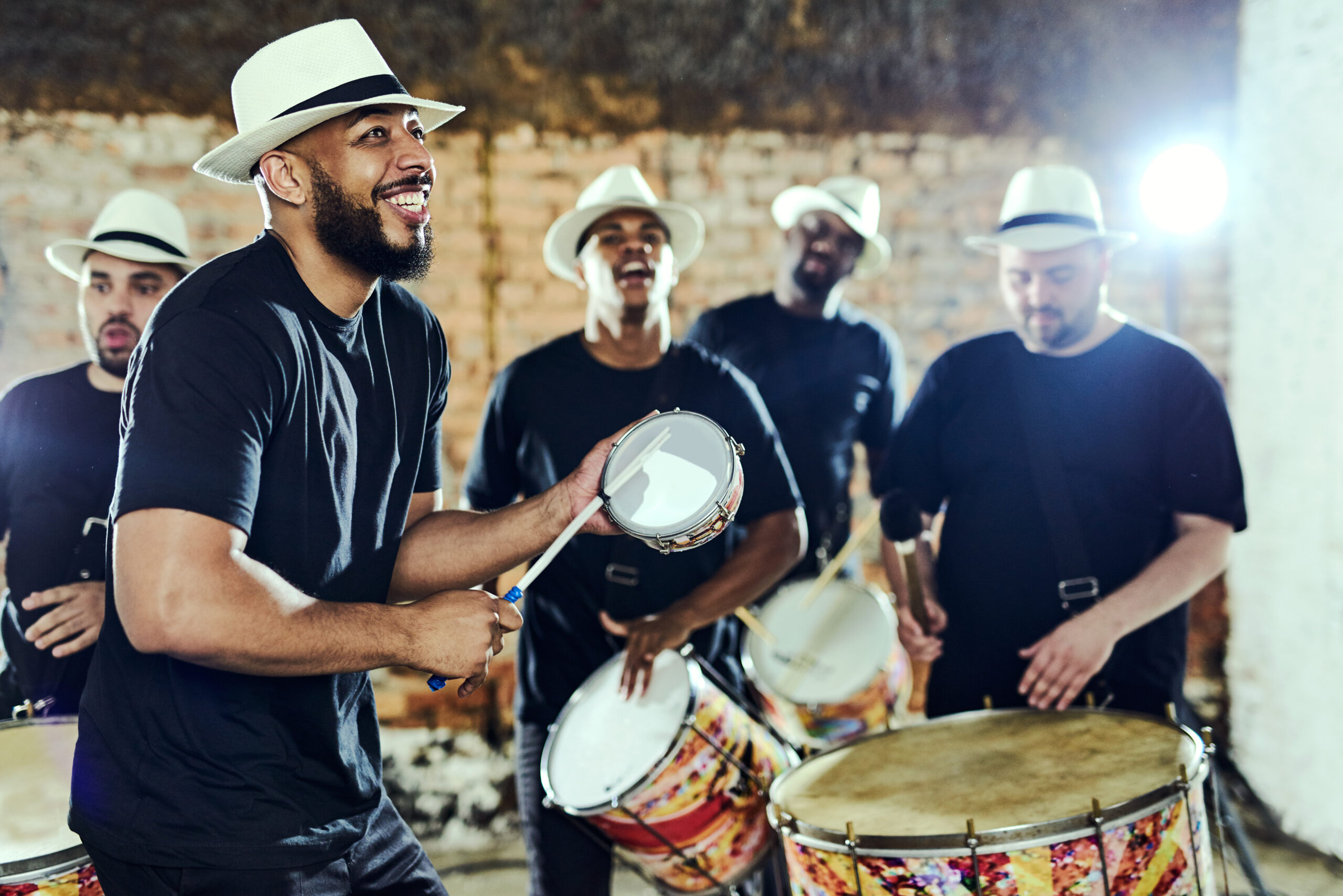
A band mysteriously assembles – a Surdo, Caixa Tamborim, a Pandeiro, Cuíca and a Cavaquinho – the heart of samba catechism magically pulled from the night air. Soon the band cranks it up to 11. You feel the music in your ribs – particularly when the Surdo drum lands – in the pavement vibrating under cheap plastic crates, in the way these women throw their whole selves into the music like tomorrow’s rent is already lost and that’s tomorrow’s problem. Above the alley, the hills glow with a scatter of favela lights, Christmas decorations that never got the memo the holiday is over.

Down here, the samba runs like an underground current, and for a few songs on a hot Rio night, these dancers are the center of the universe, holding the chaos together with nothing but rhythm, laughter, and a stubborn refusal to sit the hell down. There is poverty here, but also joy, a joy that has seen some things and come back anyway, demanding another round and a louder song.
The jet fuel for the night is cachaca. It is the city’s unofficial bloodstream, the clear, grassy thing in the well-worn glass that makes Rio’s noise tilt from chaos into something like grace. When the drums start and the bloco moves, cachaça rides in plastic cups and recycled water bottles, keeping time with the beat; it greases the joints, lowers the shoulders, and convinces shy hips to join the conspiracy.
Cachaça is Brazil’s national spirit, distilled from fresh-pressed sugarcane juice rather than rum’s molasses, which gives it that raw, green, almost bruised-sugar flavor. It is the base of the Caipirinha, Brazil’s flagship cocktail, but is also drunk neat or in a wide range of mixed drinks. In the glass it swings from clean and vegetal to funky and earthy, sometimes picking up wood and spice when it spends time in Brazilian barrels instead of stainless steel. The stuff has been around for nearly five centuries, born on colonial sugar plantations and poured first for enslaved workers as rough fuel for impossible days. It became a drink of rebellion when the Portuguese tried to ban it to protect their wine trade, sparking revolts that literally started in Rio and cemented cachaça as a symbol of Brazilianness and resistance.
In Rio’s botequins and “dirty-foot” bars, cachaça is the cheap shot lined up for construction workers, office clerks, cops, poets, and whatever washed-up gringo wandered too far from the beachfront caipirinha stands. It is the rare thing that belongs equally to the favela bar with pickled eggs on the counter and the sleek Ipanema joint serving fifty-real “artisanal” caipirinhas with single-estate cane juice. Heck, I had an ice cold caipirinha from a bar on the summit of Christ the Redeemer statue.
The most respected cachaças come primarily from a handful of traditional regions, especially in Minas Gerais, Rio de Janeiro state, Bahia, Pernambuco, São Paulo, and Santa Catarina.
Salinas (Minas Gerais) – Officially recognized with a Geographical Indication and often called Brazil’s “national capital of artisanal cachaça,” with dozens of pot‑still producers and a long aging tradition. Paraty (Rio de Janeiro state) – Historic coastal town and UNESCO‑listed area with centuries of small‑scale production; Paraty cachaça also holds an Indication of Origin and is widely promoted as a premium terroir.
Brazilian cachaça is broadly split into artisanal and industrial styles, mainly distinguished by scale, still type, and production choices. Industrial cachaça is made on a large scale, usually from machine‑harvested cane, fermented with selected/chemical yeasts, and distilled continuously in column stills for volume and consistency. Artisanal cachaça (cachaça de alambique) is small‑batch, typically from hand‑cut cane, quickly pressed, wild or mixed yeast ferments, and batch‑distilled in copper pot stills. Industrial cachaça tends to be lighter, cleaner, and more neutral in flavor, often unaged and treated as a mixing spirit, with a reputation inside Brazil similar to cheap vodka. Artisanal cachaça is often richer, more aromatic, and more complex, with terroir‑driven variation and more use of wood aging, and is marketed as a connoisseur product that can reach very high prices.
Some of the most prominent and widely found cachaça brands (both in Brazil and abroad) include:
Within Brazil, enthusiasts also talk up higher-end names like Germana, Weber Haus, Magnífica, and Anísio Santiago (formerly Havana), which are more “connoisseur” than supermarket shelf.
My advice: Get yourself a decent caipirinha – lime crushed into sugar, good cachaça over a pile of ice – and you are basically buying a one-way ticket to Rio in a rocks glass.