
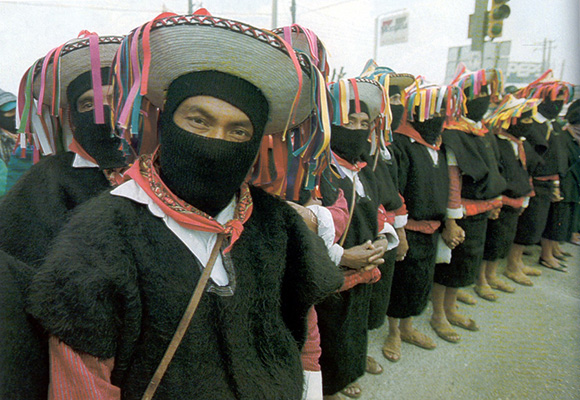
Somewhere deep in the jungle of Chiapas, Mexico, where the road ends and the real world begins, the Zapatistas have been holding their ground for three decades. They wear masks not as costume but as shield — a reminder that identity here is both weapon and wound. These are farmers, poets, and rebels without headlines, staging one of the world’s longest-running experiments in dignity.
They’ve built a kind of democracy without the press releases — a stateless project that beats back hunger with corn, coffee, and stubborn hope. Their war isn’t waged with bullets anymore, but with the quiet, radical idea that the poorest people on Mexico’s southern edge deserve a seat at the table — even if they have to build the damn table themselves.
Down here, the economic engine isn’t some faceless corporation or government grant — it’s coffee. Thick, black, and born from the same soil the Zapatistas fought to reclaim. The plantations are run by the farmers themselves, cooperative-style, where every bean carries a bit of defiance. In the early morning haze, you can smell it roasting — smoke mingling with mist, machetes clinking in rhythm.
This isn’t fair-trade branding. It’s survival, turned into enterprise. The profits don’t head north; they stay here, in the villages that time and the state forgot. Every cup poured in these mountains tastes like resistance — strong, slightly bitter, and impossible to fake.

You wake before dawn in a village you won’t find on any official map. The jungle hum is a low electric buzz, alive with cicadas and half-heard whispers. The smell hits first — wood smoke and coffee beans roasting over open flame. A rooster somewhere announces nothing in particular.
The farmers move slowly but with purpose, their faces half-hidden under faded bandanas. These are not the faceless poor romanticized in hashtags; they are landowners now — not in the capitalist sense, but in the ancient one. The soil is theirs again, the coffee trees rising like a second generation of rebellion. The beans aren’t trucked off to anonymous buyers. They’re dried, bagged, and sold through Zapatista cooperatives — the kind that don’t need permission from any ministry or multinational.
In San Cristóbal de las Casas, tourists sip the same coffee in quiet cafés, oblivious to its origins. They taste cacao and spice, maybe a hint of smoke, not realizing it’s grown in fields carved out of defiance. You drink it differently when you’ve stood where it’s made. You see the hands that grow it — cracked, proud, still stained with earth — and you realize this isn’t just a beverage. It’s an assertion of existence in a country that once pretended these people didn’t exist at all.
For travelers willing to go beyond the colonial plazas and souvenir alleys, the road south winds into something real. Visitors can tour the coffee fincas, walk the forest trails that frame their crops, and share a meal or a story with the people who tend them. It’s not poverty tourism — it’s solidarity in motion. You buy the beans directly, see where they come from, and leave knowing that your pesos did more than fund another resort. They helped patch a roof, feed a family, keep the lights on in a small school by the river.
The Zapatista land isn’t a museum or a cause you donate to — it’s alive and working. Go, if you can. Drink the coffee where it’s grown. Walk the paths they cut with machetes and conviction. It’ll change the way you look at what a revolution really tastes like: something simple, handmade, and hard-earned, served in a chipped mug beneath the emerald canopy of a rainforest.
If you drive long enough through Chiapas, past the mountain fog and the endless green, you find roads that seem to vanish into myth. Here, GPS loses its nerve, buses thin out, and the asphalt gives way to red dirt and coffee blossoms. What you find at the end isn’t a “destination” in the guidebook sense — it’s a living social experiment disguised as a cluster of humble villages.
The Zapatistas have turned survival into an act of rebellion. Their schools teach collective history; their clinics run on mutual aid. And their economy — the quiet heartbeat of it all — runs on coffee, grown high in the hills under the same sun that once dried rebel banners. It’s not Starbucks-country. It’s subsistence-country — where every bag of beans carries a trace of philosophy, a manifesto written in the language of soil.
Travelers who come here do so deliberately. There’s no five-star lodging, but there are hammocks, hand-pressed tortillas, and coffee so strong it could raise the dead. The co-ops welcome visitors who want to see the process — seed to cup, machete to mug. You walk the rows with farmers who speak softly but carry the weight of decades on their shoulders. They’ll show you how the harvest works, how roasting turns the beans a dark, greasy brown, and how each bag sold keeps an entire community breathing.
You can base yourself in San Cristóbal de las Casas, a mountain town draped in murals, protests, and the smell of roasting beans. From there, colectivos and local guides connect you to Zapatista-affiliated villages — Oventic, Morelia, or La Garrucha — autonomous zones running their own affairs, independent of the Mexican state. Permissions are sometimes required, but the journey itself is half the point. You’re not an observer; you’re a guest in a world built deliberately outside the system.
There’s no luxury in this experience, and that’s its quiet brilliance. You stay where the people stay, eat what they eat — beans, corn, eggs, hand-ground salsa from the garden. Nights hum with insects and distant guitar strings. Mornings are for work — sorting, bagging, roasting, stamping “Producto Autonomo” on each sack. Buy it directly from them, not from intermediaries or “ethical” middlemen. Your pesos cut through the noise of bureaucracy and drop straight into the hands calloused by a lifetime of labor.
And when you leave, you carry more than coffee. You carry an understanding — that this isn’t about nostalgia or romantic rebellion. It’s about a group of people who refused to vanish, who built a living, breathing alternative tucked into the folds of the jungle. The Zapatistas don’t need saviors, and they aren’t waiting for approval. They just keep feeding their children, teaching their history, and growing the beans that have quietly become the most revolutionary drink in Mexico.
Come here if you can. Go slow. Listen more than you talk. And when you finally sip that coffee under a tin roof in the clouds, surrounded by strangers who no longer feel like strangers, it might hit you — this is what real change tastes like. Smoke. Sweat. Dignity. Hope.