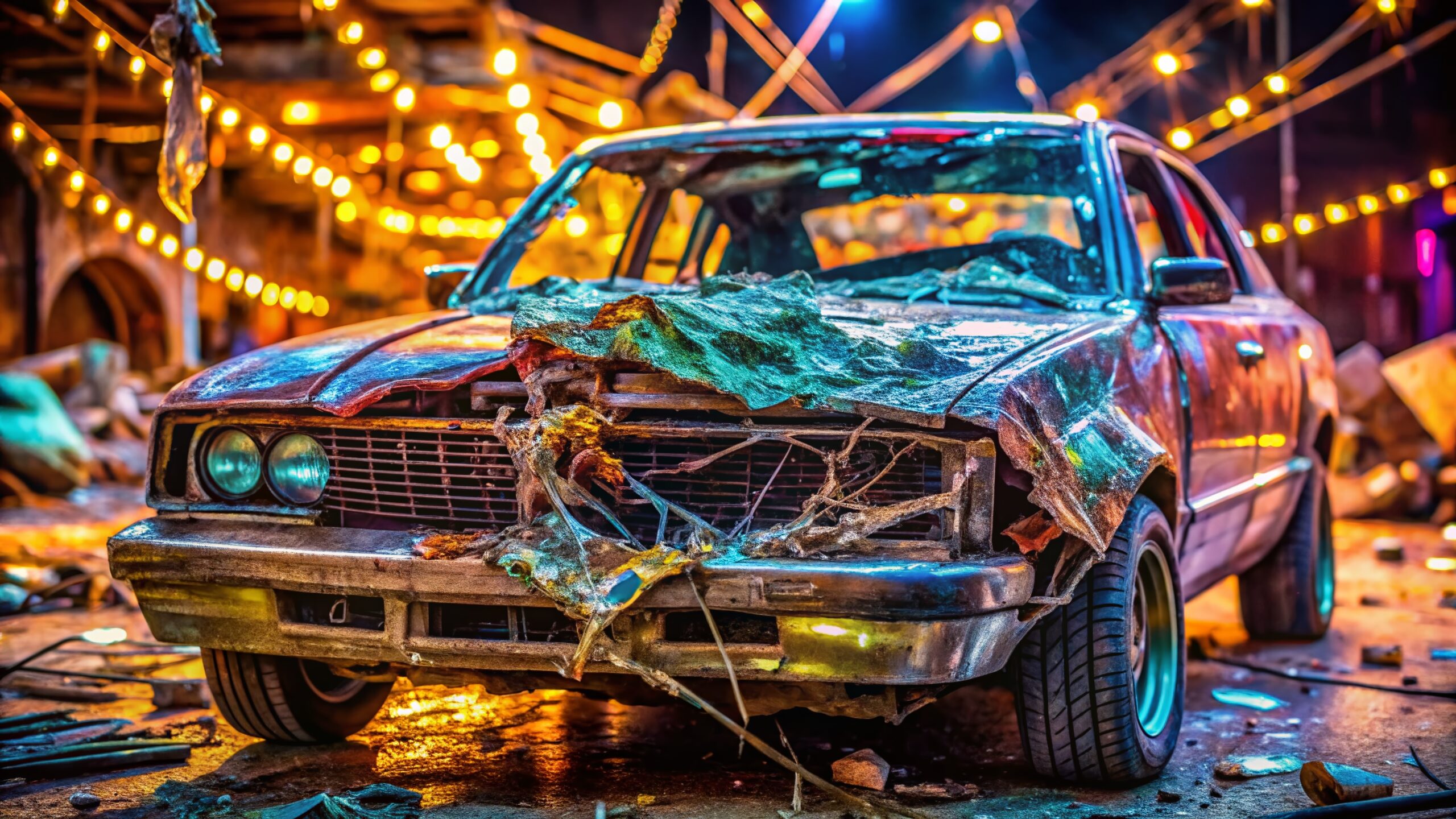
When I was a kid, Saturday mornings were a full-body narcotic. A steady drip of cartoons blasting through our cheap Zenith until the mind went soft and the world blurred into commercials and cereal mascots. But once the noise faded, the UHF ether hissed alive with something holy and deranged—the Demolition Derby, the last unvarnished cathedral of American zeitgeist. Those weren’t mere cars; they were dying beasts. Rusted Fords and Chevys resurrected from scrapyard purgatory, patched with chicken wire and pure bad intention. When the green flag dropped, they screamed across the dirt like the ghosts of Detroit laborers demanding a final encore.
The kiddie dodgem ride at nearby Canobie Lake Park was no substitute for the real deal. All I knew then is that I wanted to drive in an actual derby someday. If you join me in this mad quest, read on.
Of course, In a demolition derby, the basic goal is to keep your own car running while crashing out and disabling everyone else’s. The winner is the last driver whose vehicle can still move under its own power and make contact with another car.
I remember staring at the screen, entranced, as mangled hulks collided in slow, operatic violence.
That was therapy, a full‑metal exorcism. You didn’t just drive—you purged your demons, screaming through smoke and twisted fenders, until the world made sense again. It was the mechanical gospel of the half‑mad and fully alive. Those weren’t cars; they were dying beasts. Rusted Fords and Chevys resurrected from scrapyard purgatory, patched with chicken wire and pure bad intention. When the green flag dropped, they screamed across the dirt like the ghosts of Detroit laborers demanding a final encore. Caligula himself would’ve danced in the owner’s booth at the Colosseum, eyes wild, shouting for more gas, more carnage, more proof that the empire still had teeth.
That’s the secret heartbeat of the derby. It’s not nostalgia, not sport—it’s defiance. A middle finger raised to safety ratings and suburban decay, to the idea that all destruction is waste. Under the haze of motor oil and fireworks, something real survives: the wild, unkillable faith that chaos, at full throttle, might just be the last honest American art form.
By 1972, this hillbilly gladiator sport had become so popular a nationally-televised derby was held at the Los Angeles Coliseum featuring Indy 500 champs (Bobby Unser, Al Unser, A.J. Foyt, Mario Andretti and Parnelli Jones) smashing brand new cars along with daredevil Evel Knievel in his Rolls Royce.
Derby culture still thrives where America keeps its callouses: the rural Midwest, the fairgrounds of the South, the beer‑soaked fields of nowhere towns that refuse to die. Places where people understand that creation and destruction are the same damn thing if you do them with enough heart. They turn rust into art, junkers into brief legends, and pain into noise. Writers and promoters describe derby culture as tied to rural aesthetics of rust, decay, and DIY ingenuity—turning old beaters into short‑lived gladiator machines. Analyses read the derby as a “rite of reversal” where working‑class drivers symbolically push back against corporate America by destroying its ultimate status symbol: the automobile.
Maybe that’s why the derby endures. Underneath our tech utopias and plastic futures, there’s still a part of us that craves the crash—something brutally honest, stripped of polish or pretense. A reminder that steel can still scream, that madness still has its place in the sun, and that somewhere out there, under the fairground floodlights, the real America is still slamming into itself, grinning through the smoke.
So, let’s get down to brass tacks: you and your overly-civilized, oft-times whipped crew of buds needs to compete in a demolition derby – now. Here’s what you need to know.
In the US and Canada, demolition derbies became a staple of county and state fairs from the 1950s–60s onward, particularly in rural areas, and remain among the most-attended events at many small tracks and fairs. Regions with strong fair and stock‑car traditions—Midwest, parts of the Northeast, pockets of the South—host dozens of local and regional derbies each year.
- At many county fairs the demolition derby is the night when stands are fullest; it functions as a social ritual that mixes family entertainment, local bragging rights, and a bit of sanctioned mayhem.
- Regional promoters such as Hard Core Derby Promotions or Derby Icons publish rulebooks, event calendars, registration forms, and contact info so drivers can enter directly and ask questions about classes, safety, and car eligibility.
- Multi‑event outfits like Sunnyside Promotions or Mad Dog Demolition Derby’s Motorhead Events sites centralize rules and entry forms so you can sign up for several fairs through one organization and get guidance on requirements.
- The beauty of a Derby Weekend with the boys is you can rent an entry car and then leave its sorry ass on the field after you’ve destroyed it.
- Some local promoters offer a small fleet of “rigs” to rent for their own events, bundling use of the car with entry fee and basic equipment for a low per‑event price.
- Search derby‑focused forums and Facebook groups for posts offering “turn key car,” “roller to turn key,” or “custom built derby cars,” then vet the seller’s reputation and ask for photos and a build list that you can show to your promoter’s tech inspector.
- Check classifieds and local derby communities around the track or promoter you plan to run with; many experienced drivers sell proven cars after a big show, and these often only need minor updates to meet your event’s current rules.
Many derby communities have individuals who advertise a demolition derby car “for rent” for a flat fee (for example, around a few hundred dollars plus a deposit), usually in local Facebook groups or classifieds dedicated to derby cars.
Local “demolition derby cars for sale / buy-sell-trade” Facebook groups often have derby-prepped cars that could be used for a single event, either for sale or occasionally for rent. Derby forums, classifieds on racing sites, and YouTube communities discussing “how to find a derby car” point to junkyards, small used car lots, and word-of-mouth in derby pits as the main sources of cheap, ready-to-run beaters.
Get in the Arena
Operators / Promoters
These are examples of established demolition‑derby promotion outfits you can look up and then narrow by region:
CountyFairgrounds “Find a Demolition Derby” – Aggregates promoters like International Demolition Derby and R&R Total Destruction Promotions with states covered and contact names.
Fair Demolition Derby Promoters – Northern Ohio–based outfit that serves fairs and festivals, with rules and event info on their site.
Derby Icons – Long‑running “big show” promoter out of Illinois associated with major events like Metal Mayhem.
Smash It Demolition Derby – Large Midwest promoter that started in the late 1990s and now runs derbies at numerous county fairs.
Hard Core Derby Promotions – Promotion team focused on preserving and growing the sport, with its own rule sets and events.
USA Demolition Derby – National‑scale organizer posting a running schedule of derbies around the country.
Facebook groups (drivers, fans, promoters)
These are active Facebook hubs where drivers and promoters share builds, schedules, and rules:
“demolition derby driver’s” – General group for events and sharing derby content; good for finding shows and asking promoter questions.
Northeast Demolition Derby Drivers – Regional group for drivers in the Northeastern U.S. to post pics, videos, and event news.
FLORIDA DEMO DERBY DRIVERS – Florida‑specific community for builds, videos, and event chatter.
NorCal Derby – Northern California group covering rules, events, build techniques, and gear for the West Coast crowd.
Fueled Bye Haterz – Broad derby fan/driver group focused on builds, help with projects, and lots of video content.
Hard Core Derby Promotions Group – Official community hub for Hardcore Derby Promotions, including rule updates and youth/adult class qualifiers.
Demolition Derby World: Promoters and Drivers Coexistence – Discussion space about the promoter–driver relationship and how shows are run.