
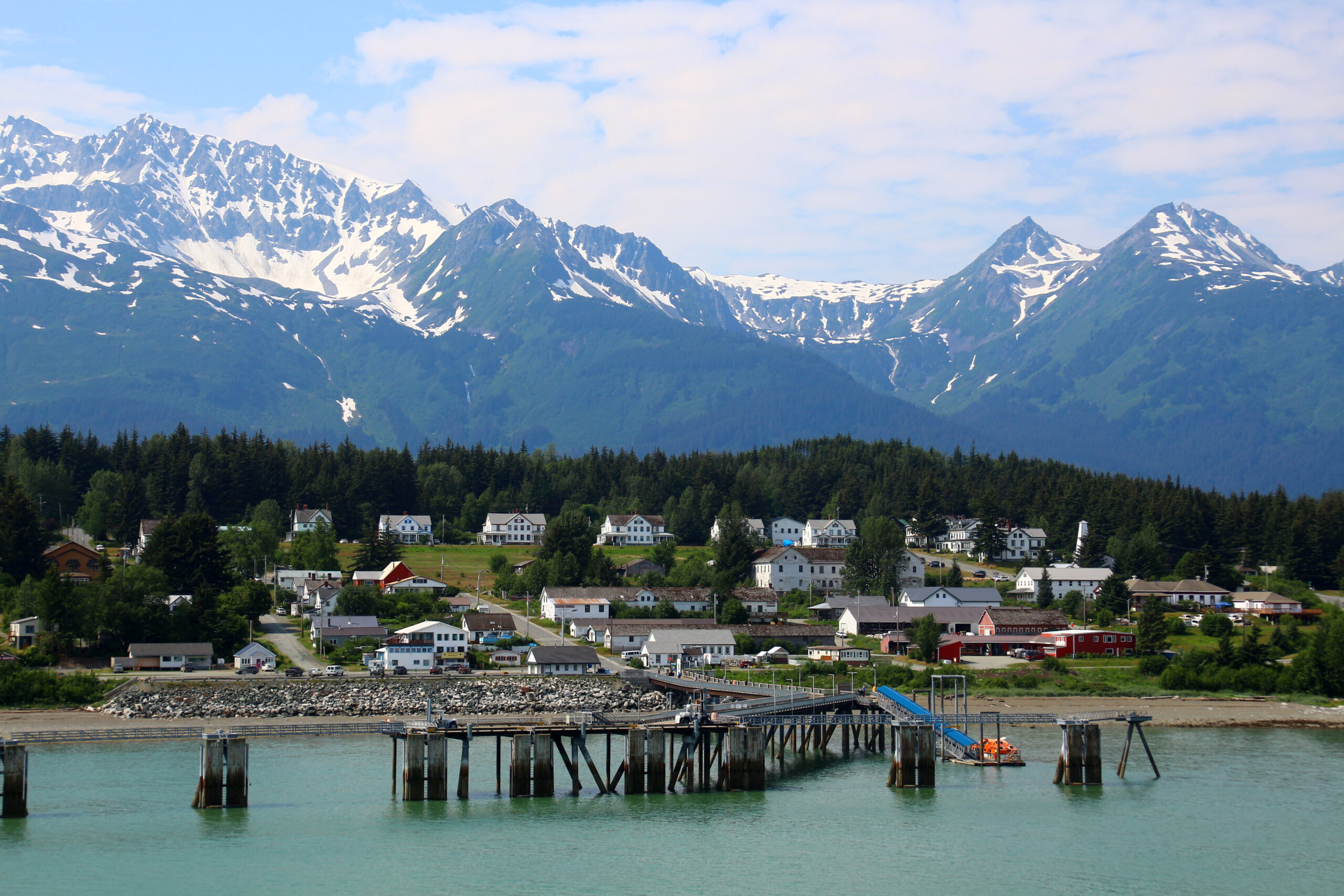
I am back in Haines, Alaska. This time I am here for a personal ceremony – I am being adopted into the Tlingit tribe of the village of Klukwan. It’s a wild story for another post.
By the afternoon, I am at a potlatch in the village longhouse and where I am given the Tlingit name Góoch éesh (“wolf father”) and a beautiful vest with wolf image beadwork. It’s a proud day.
With the rest of the week I decide to get to know nearby Haines better.
Haines is a hard little harbor town at the end of the American dream, wedged between ice-bitten mountains and a deep black fjord, where bald eagles crowd the gray sky like slow, circling sentries.

The hamlet sits on the shores of the Lynn Canal, a long, glacial fjord where mountains rise straight out of the water and the weather comes on like a mood swing.
The town is small—only a few streets, no stoplights, 2,500 souls give or take—but it feels bigger than itself, inflated by the surround of peaks, forest, and cold sea.
I am in town for a personal ceremony: I am being adopted by the Tlingit tribe of Klukwan. At a potlatch I am given the Tlingit name Góoch éesh (“wolf father”) and a beautiful vest with wolf image beadwork.
Long before anyone called it Haines, the Tlingit knew this place as Deishú, the end of the trail, a last stop between the hinterlands and salt water.
Missionaries, gold fever, salmon canneries, and an old Army outpost called Fort Seward layered on afterwards, leaving weathered wood, rust, and stories that never quite made it into the brochures..
Klukwan is organized around the classic Tlingit two‑moiety system: Raven and Eagle/Wolf, with specific local clans that anchor the village’s identity and history.
Haines is essentially the front porch to Klukwan, the “eternal village,” where Chilkat Tlingit clans still live their language, clan system, and ceremonial life as they have since time immemorial. The Tlingit’s have been in this very spot for somewhere between 4,500 and 10,000 years.
If they had one, the Haines chamber of commerce would sell the town as scenic—bears on the river, eagles by the hundred over the Chilkat, hikers and cruisers chasing some manageable bite of wild.
But walk it slow and you feel something else: the semi-isolated hush of a town at the edge of the map, given as much to the gutter as to the gods, surviving on tourism, stubbornness, and the strange metaphysical charge of simply hanging on here.
Haines is an oddball, human-scale town.
“Downtown” is a few streets of galleries, cafés, harbor, local breweries, and the unapologetically weird Hammer Museum—the world’s only museum dedicated purely to hammers.
Fort Seward’s old Army buildings now hold art studios, inns, and bars, so you drink and wander through a half-ruined parade ground with the mountains leaning over your shoulder.
I am here this time in spring which means only one thing hereabouts: the Hooligan Run.
The hooligan run is the huge spring migration of eulachon—small, oily smelt also called hooligan or candlefish—from the open ocean into coastal rivers like the Chilkat and Chilkoot around Haines, Alaska, to spawn. Hooligan are anadromous fish, meaning they live in the ocean but swim upriver in massive schools each spring to reproduce, turning stretches of water into a dense, moving ribbon of silver.
For Indigenous peoples such as the Tlingit in the Haines–Klukwan area, hooligan have long been a vital subsistence resource, harvested with dip nets, rakes, and traps as one of the first major food sources of spring. The run is also a critical early-season food pulse for predators: gulls, sea lions, eagles, seals, and occasionally whales gather in striking numbers to feed on the fish.
Hooligan are eaten fresh, often fried whole, baked, smoked, or dried, taking advantage of their very high oil content. Families freeze, smoke, and dry them for year‑round use, serving them as everyday meals and at gatherings
First daylight during the frenzy brings out Chilkoot dip-netters, a loose order of true believers and warriors, standing ankle-deep in glacial runoff, swearing, smoking, cracking jokes as they drag forever out of the river and into beat-up plastic totes.
Soon it will be summer and salmon, and tourists looking for kayaking, hiking, and long blue evenings.
Winter flips to Stockholm-like darkness, steep backcountry skiing, the Bald Eagle Festival, and a small-town scene that doesn’t disappear when the ships do.
Where is it?
How far is it?
How to get there
Things to know
Big nature without big crowds
Chilkat Tlingit culture next door
If you’re dreaming about edge-of-the-map communities, Haines and Klukwan is a stunningly beautiful case study on how a place rides tourism, subsistence, and old stories all at once.