
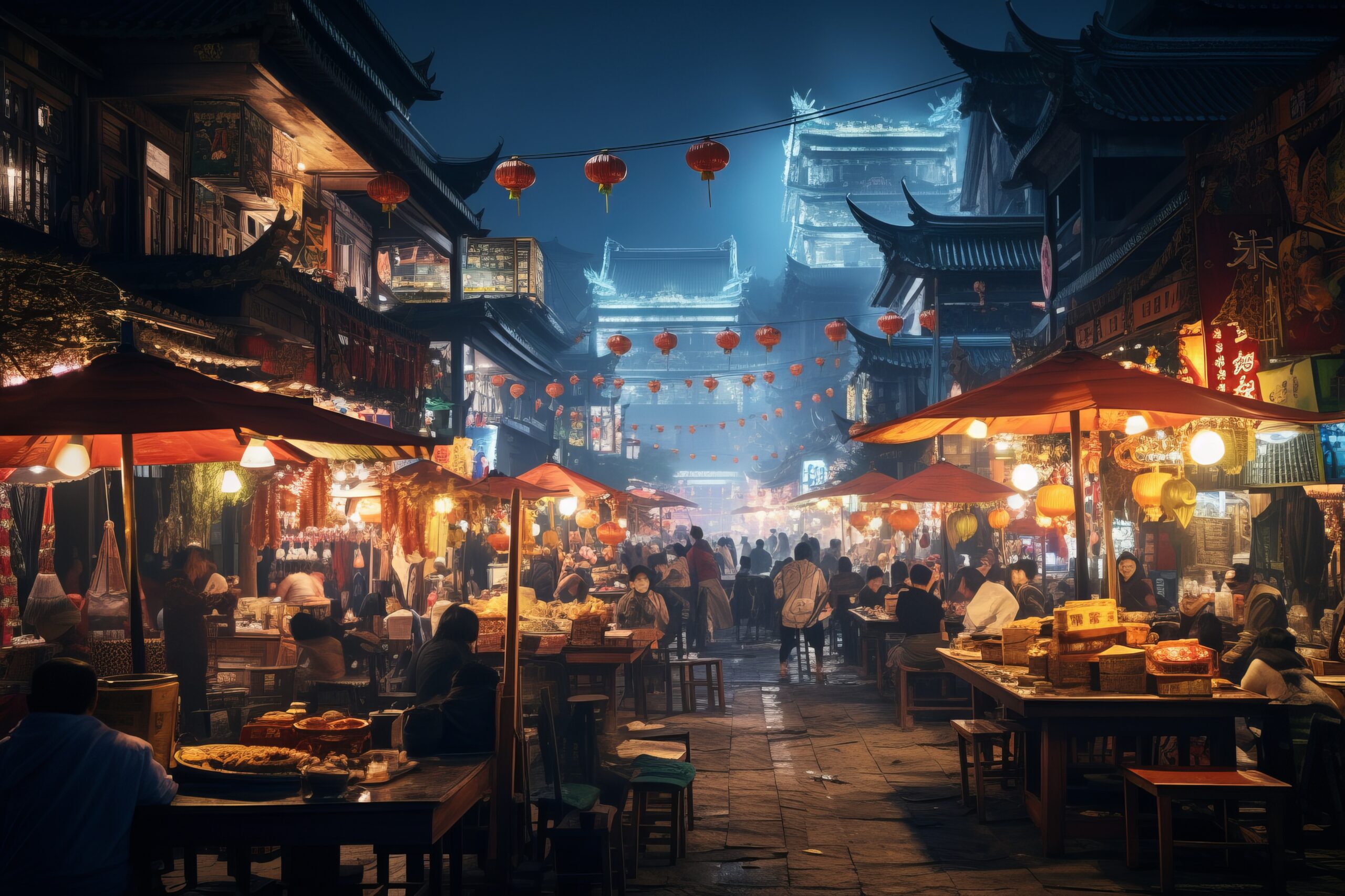
A night market isn’t some peddler’s swap meet dragged under a sodium light—it’s a different animal altogether.
It breathes and hums with manic purpose, thrumming in the blood like a low, electric fever. You don’t march through a night market; you sink into it, chewing and drifting and gorging on the noise. It’s not commerce—it’s communion, food as narcotic, chaos as oxygen. A night market feels like a street that decided it was done with respectable daytime work and gave itself over to animal appetite and feral noise. It is less “place to buy things” than low‑grade carnival, a nightly combustion of food smoke, neon, and human drift.
The idea street takeovers originated in China during the Tang dynasty, when night trading began despite early state restrictions, then exploded into a core part of urban nightlife by the Song dynasty. The markets spread across East and Southeast Asia and later into Chinatowns and festival-style markets in cities around the world, carrying the same basic DNA: food, bargaining, noise, and light.
The air is thick: frying oil, grilled meat, incense, sugar, exhaust, and sometimes the metallic tang of rain on hot pavement. Sound comes in overlapping layers—vendors barking, woks ringing, music leaking from cheap speakers—until it becomes a single, steady roar you move through rather than listen to.

Stalls specialize in quick, hand-held dishes—xiaochi, or “small eats” in Taiwan—that function as both everyday sustenance and edible folklore.
Skewers, noodles, offal, seafood, sweets, and regional oddities become a public tasting menu of local culture, where trying one more dish is both research and dare. Beyond snacks, they have long housed performers, games, sometimes red-light trade and small hustles, making them unofficial theaters of the city’s desires and contradictions.
People don’t just shop; they flow. Families, teenagers, workers just off a shift, and tourists all fold into the same slow shuffle, pausing wherever the steam, the skewers, or the knockoff sneakers catch their eye. There is “order in the chaos”: stalls crammed together, bodies close, yet everyone somehow sliding past without quite colliding. Night markets operate as democratic living rooms where classes and generations mix, turning food into a medium for cultural exchange and the maintenance of local identity.
The holiest of night markets cluster in East and Southeast Asia, like some fever chart of human urges where the mercury never drops, it only hisses and climbs. Out there the sun goes down and the real liturgy begins: tarps lashed to rusted poles, extension cords daisy‑chained like bad decisions, grease popping in woks that have forgotten what it means to ever cool.
Taiwan and Thailand sit in the middle of it all like twin black stars, pulling in curious tourists, lost romantics, gig‑economy exiles, and the last true believers in the sacrament of cheap meat and open flame.
In Taipei, the air itself is a living thing—fried chicken vapor, incense smoke, and the low animal murmur of a thousand small hustles, none of it asking permission. Neon bleeds onto puddles of gutter water, and you follow the smell of stinky tofu the way a sinner follows church bells, not because it’s holy, but because something in you wants to be judged. Men with faces like old apples stand over vats of oil, turning skewers with a casual indifference that borders on murderous tenderness, and every stall light swings in the night breeze like a bare bulb in an interrogation room where the only question is how hungry you’re willing to admit you are.
Bangkok hums at a different voltage—louder, hotter, a delirium where traffic, flesh, and faith grind together until distinctions stop mattering. The markets sprawl and mutate: one night it’s a train‑line bazaar, another it’s a parking lot reborn in diesel fumes and chili smoke, with plastic stools as pews and beer towers as communion. You eat standing up, sauce on your wrist, exhaust in your lungs, surrounded by a mishigas of things you will never fully understand: amulets, knockoff sneakers, grilled squid still shining with the ghost of the sea, and teenagers who have never once believed that the world was anything but theirs.
Far away, in the dark folds of Africa, the wild cards burn their own strange constellations into the global night. In Marrakech, Jemaa el‑Fnaa turns from a sun‑blasted square into a vision out of some half‑remembered scripture, rewritten by street hustlers and grill men who know exactly how close ecstasy lives to smoke and noise. In Richmond, beneath the sanitized glow of a rich country’s comfort, a parking lot becomes a borrowed hallucination of Asia: skewers, sugar, neon, and the old immigrant alchemy of making a new world smell like the one you left behind.
Call it commerce, call it tourism, call it whatever makes the ledger balance; beyond the LED lights and QR codes it is older than any of that. It is fire and flesh, hunger and noise, the ancient marketplace dressed in plastic and vinyl, still doing the same dirty holy work it has always done: feeding the living, one paper plate at a time. Like a sailor’s girl in every port, here are some of my favorite night destinations.
Bangkok, Thailand – Universally framed as a “street food paradise,” with dizzying variety from pad thai and curries to grilled squid, especially around Chinatown and backpacker corridors.
Penang, Malaysia – Classic hawker‑center heaven, mixing Malay, Chinese, and Indian influences; often described as the top street‑food spot in Malaysia.
Kuala Lumpur, Malaysia – Frequently defended by food obsessives as having some of the best street food in the world even if it’s less known for fine dining.
Saigon/Ho Chi Minh City & Da Lat, Vietnam – Multiple sources argue Vietnam has “hands down” the best street food; one 2025 list even crowns Da Lat number one street‑food city globally.
Taipei, Taiwan – Famous for dense night‑market culture (Shilin, Raohe, Huaxi/Snake Alley) with everything from classic snacks to snake, turtle, and other exotics.
Mumbai, India – Ranked among the top food cities worldwide in 2025–26 and celebrated for chaats, vada pav, pav bhaji, and other intense, fast street bites.•
Delhi, Amritsar, Hyderabad, Kolkata, Chennai – All land in the global top‑100 food cities, largely on the strength of regional street traditions (chaat, kulcha, kebabs, dosas, biryani).• Istanbul, Turkey – Regularly cited in street‑food roundups for simit, döner, kokoreç, fish sandwiches, and late‑night grills threaded through ferry piers and alleys.
Mexico City, Mexico – Nearly every street‑food list calls it top tier: tacos al pastor, carnitas, suadero, tamales, tlacoyos, esquites, and tortas are everywhere.• Lima, Peru – Recently pushed into the global top‑10 food cities, with cebicherías, anticuchos, and market stalls feeding a strong street and market culture.
Cartagena, Colombia – Highlighted for carts selling arepas and grilled meats that turn streets into open‑air grills.
Naples, Italy – Crowned number one food city in a major 2025–26 ranking; while more “street‑adjacent” than hawker‑style, pizza al portafoglio and fried snacks function as local street food.
Rome, Italy – Pops up in “best street food cities” lists for suppli, pizza al taglio, porchetta panini, and other walk‑and‑eat staples.
Portland, Oregon – Known for food‑truck pods using local ingredients, part of a growing ecosystem of night markets nationally.
Night market crowds compress the distance between strangers; you’re shoulder‑to‑shoulder at a stall, sharing a table with people you’ll never see again, laughing at the same too‑spicy bite. That ad hoc, unplanned community—built on rickety stools, paper plates, and shared curiosity—is where the night market stops being just a place and starts feeling like a brief, passionate tryst.