
The road out of Kigali unravels like a bad idea you were somehow proud to have. Dawn slides over the hills in sheets of fog and diesel, and the whole country feels like it had one foot in Sunday mass and the other in some deep, volcanic fever dream. The driver guns the Land Cruiser around another blind curve, crucifix swinging from the rearview mirror as if it wanted to bail out, and then you remeber—too late—that you paid real money to be driven directly into the kingdom of a 400‑pound animal who could end rearrange your dental structure in about three seconds.
Volcanoes National Park rises ahead in jagged silhouettes, a line of extinct monsters crouched on the border, their flanks soaked in mist and bamboo. You don’t visit this place so much as submit to it. The briefings at park HQ feel like a courtroom: trackers in green, tourists in high-performance guilt-wear, and a ranger explaining, with the calm of a hangman, that a gorilla permit costs more than a used car for a reason—conservation, limited numbers, only a handful of humans allowed each day, one hour on the clock once you find them.
The guide assigned to the group—Emmanuel, a man with a machete, a PhD in mud, and the patience of a monk—smiles like he’d seen this twitchy foreigner routine a thousand times. “We go slow,” he said. “The forest decides the speed.”
The forest does not go slow.

It closes around you like a conspiracy. Bamboo thickets, vines with a personal grudge, black soil that swallowed boots and any lingering illusions of control. Somewhere up ahead, unseen trackers move like ghosts, radioing positions, reading signs in snapped stems and shadowed prints the way Wall Street reads charts—except these patterns matter. Breath goes ragged, thighs burned, and the expensive travel insurance policy sitting in your email inbox feels suddenly theoretical.
Then the jungle hiccups.
A smell—earth, musk, something rank and royal—rolls through the clearing. Leaves tremble. Emmanuel raised a hand and, just like that, the manic trudging stops. The radios crackled once, softly, like a secret being confirmed. “They are here,” he whispers “The family.”
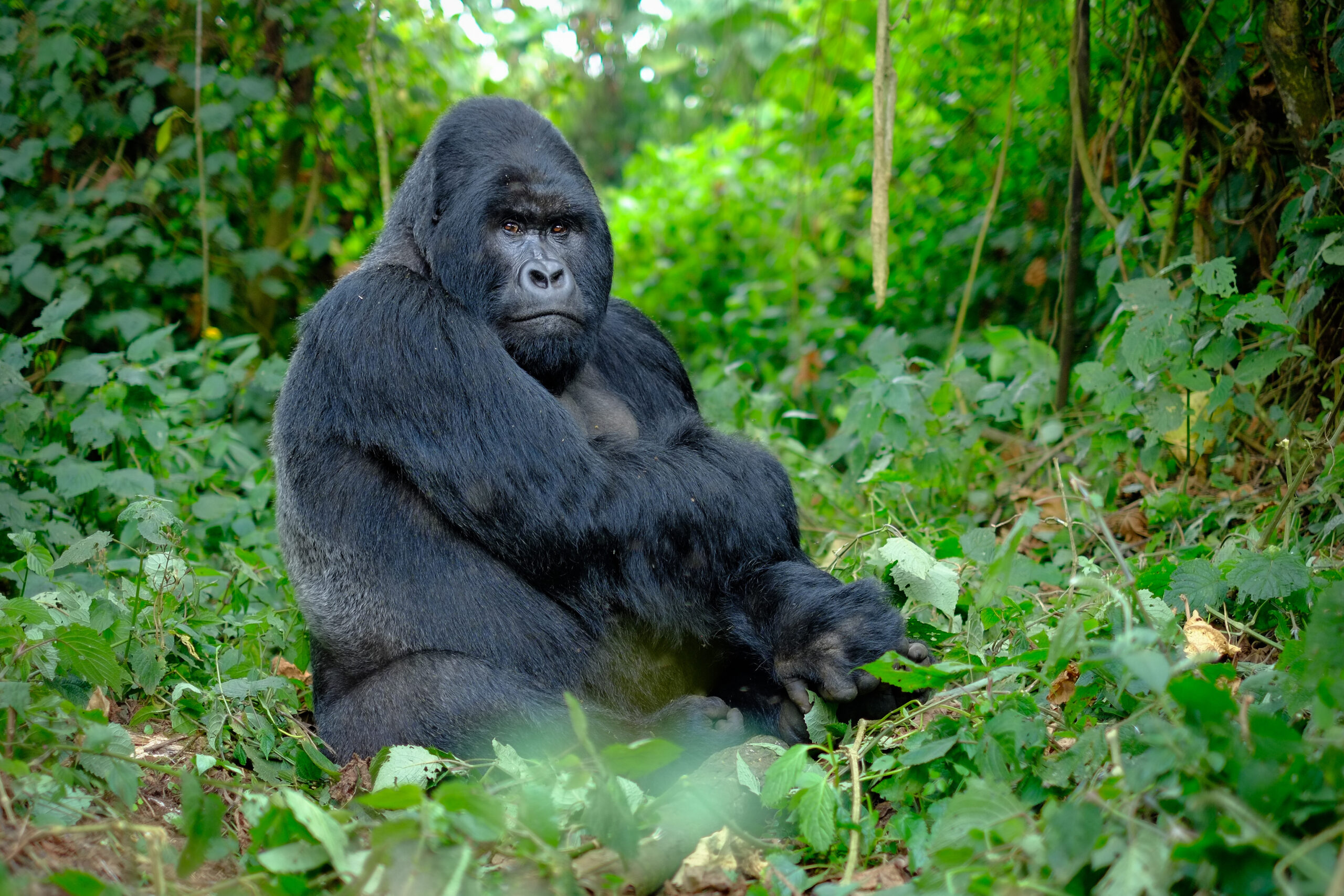
The first gorilla appears the way truths do in bad dreams: too close, too sudden. A juvenile, black-furred and bored, chewing on bamboo like a delinquent with a stolen cigar. Behind him, females materialized in the foliage, heavy and unhurried, infants clinging like small, furry satellites. Then he arrives.
The silverback comes in sideways, a tectonic shift in the undergrowth. No entrance music, no drama—just mass and inevitability. His back flashes that streak of old-warrior silver in the dull light, every pound of him radiating an authority that made human status symbols look like cheap plastic toys. He sits, turns, and finally pins you with a look that rearranges the furniture in the back of the brain.
This is not an animal encounter; it was a hostile interview with reality.
You are close enough to hear him breathe—wet, deliberate, unconcerned. The ranger mutters rules: seven meters, no flash, no sudden movements, no attempt to pretend you matter in this equation. Cameras chatter anyway, a small mechanical panic. The silverback watches all this nonsense with the mild irritation of a bartender near closing time. One grunt, a lazy chest shift, and the whole group flinches as if the sky moved.
The clock starts. One sanctioned hour in the presence of a creature that survived poachers, politics, and human stupidity to sit here, in this dripping cathedral of vines, ripping up vegetation like receipts. It’s not the danger that burns; it’s the humiliation. You traveled across continents, drove up volcanoes, paid a small fortune, and every cell in your body is screaming that this, finally, is something more important than you.
A baby gorilla clambers up his arm, punches half-heartedly at his throat, then tumbles off in a tangle of limbs, and the big male rumbles a sound that might be approval or boredom. The guide leans in just enough to murmur: “He is relaxed. When he is angry, you will know.” No one asks for details.
Somewhere in that hour, the whole circus—the lodge brochures, the heroic Instagram narratives, the conservation talking points—burns away, and what remains is simple: a giant, indifferent primate living correctly in a world humans have mostly broken. Your fear dissolves into something stranger: envy.
And then, like any decent hallucination, it ends too soon.
The ranger signals time. The silverback turns his back on the group and moves deeper into the green, taking the gravity of the moment with him. The family follows. Leaves close. The forest swallows the evidence. You stand there in the steaming quiet, heart still punching the ribs, realizing that the most honest thing you can write about this whole operation is that you were allowed, briefly, to orbit a world that functions perfectly without you.
Back at the trailhead, mud-caked and giddy, someone asks if it was “worth the money.” The only honest answer is yes—for you, for the park, for the uneasy pact between curiosity and survival that keeps gorillas alive and your own species vaguely redeemable. But the real cost is not financial; it’s the permanent damage done to your ability to take zoos, office meetings, and civilized conversation seriously ever again.
You met the king, and you walked away. That’s the hook. The rest is just logistics.
Practical gorilla trekking basics
Recommended tour operators
How Not to Die in the Jungle
Staying alive around silverbacks in Rwanda is mostly about respecting that you are a guest in their house and they are 400 pound tanks with opinions. These five hacks keep both you and the gorillas out of trouble.
1. Keep real distance, always
Stay at least 7–10 meters (22–33 feet) from the gorillas, even if they come closer; distance reduces the chance of aggression and disease transmission.
Never reach out to touch or feed them; even a “gentle” contact can be read as a threat or pass on human illness.
2. Let your guide be your brain
Follow your ranger’s instructions without improvising; they know each family’s mood and have protocols for approach, retreat, and emergencies.
Stay with your group and do not wander off for a better angle or solo shot—most bad situations start when someone drifts.
3. Talk less, move slower
Keep voices low, move slowly and deliberately, and avoid sudden gestures or rushing into position for photos.
Avoid direct eye contact and don’t point at gorillas; staring or gesturing can be read as a dominance challenge.
4. Protect gorillas from your germs
Do not trek if you’re sick with flu, cold, or other contagious illness; gorillas can catch human diseases and die from them.
Expect masks, hand‑sanitizing, and health checks at the park gate—comply fully; this protects their health and keeps the permits flowing for everyone.
5. Know how to react if things flip
If a gorilla approaches, stay calm, make yourself smaller by crouching, and avoid sudden moves; let it pass while listening to the guide.
If a mock charge happens, do not run—running can trigger a real chase; follow the guide’s pre‑briefed instructions instead (often staying still or slowly backing away).