
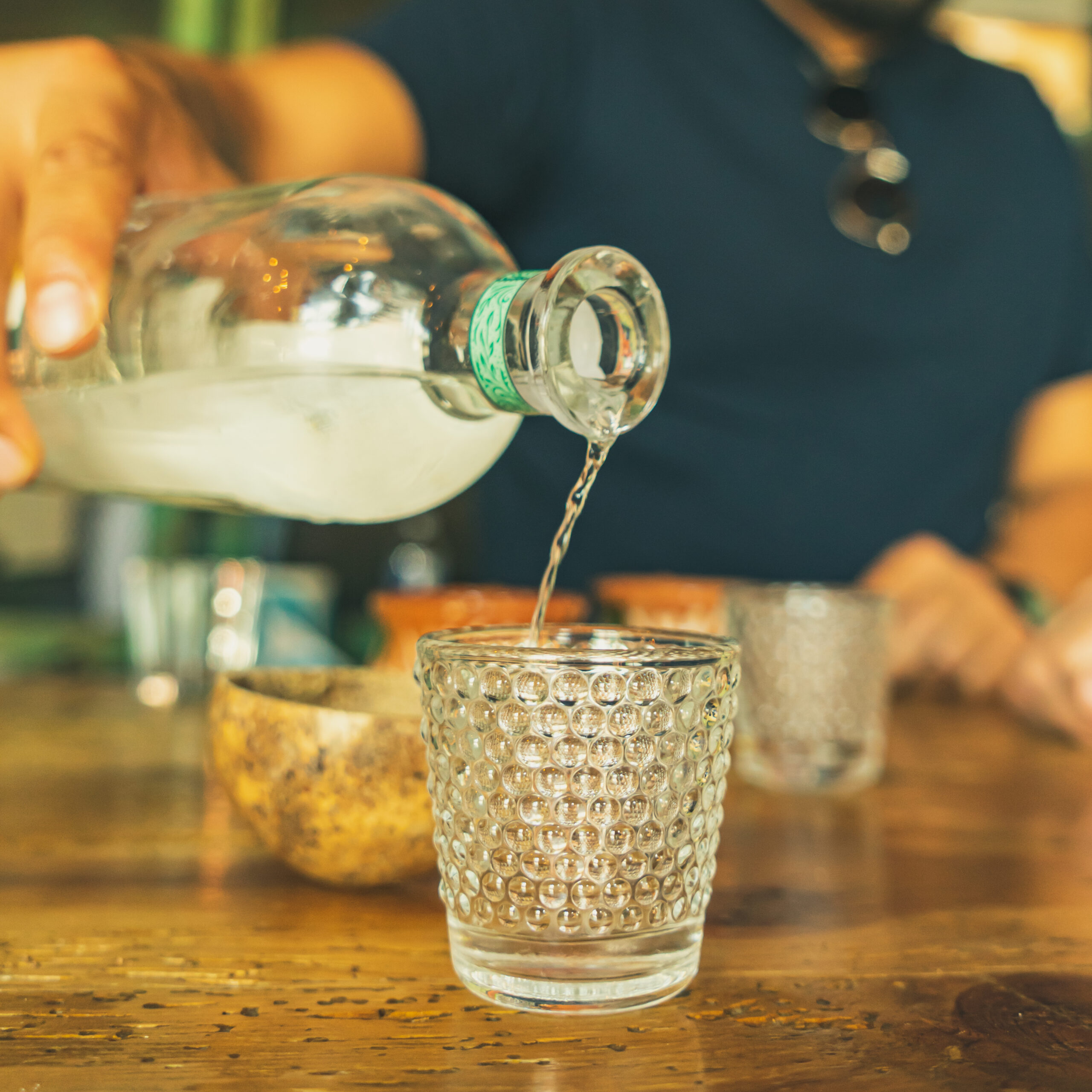
There’s a road out of Oaxaca City that winds like a lazy thought through dry hills and cactus fields. By the time you’ve left the city proper, the sounds of honking collectivos and market vendors fade to silence, replaced by the slow rhythm of a bus engine and the smell of dust and wild maguey baking under the sun. Out here, time doesn’t move forward so much as it lingers. This is mezcal country—the real one, before the export warehouses and tasting flights. The land of pit ovens and cracked hands, where the palenques sit quiet until someone lights the fire, and then suddenly you’re surrounded by a scent so deep and smoky it feels like the desert itself breathing out.
Mezcal is a Mexican spirit distilled from the agave plant, known for earthy, often smoky flavors and deep ties to traditional, small-scale production. It is an umbrella term for spirits distilled from agave; tequila is actually one specific type of mezcal made only from blue agave. Tequila is the polished cousin that got the good job, the PR firm and the celebrity endorsements, while mezcal stayed out in the sticks, smoking in pits and picking fights behind the cantina. The word comes from the Nahuatl “mexcalli,” meaning “cooked agave,” reflecting how central roasted agave is to the spirit. Mezcal can legally be produced in certain denominated regions, with Oaxaca as the best-known heartland, though agave spirits are made across much of Mexico
At one such palenque outside Santiago Matatlán—“the world capital of mezcal,” they call it—a man named Don Chepe stands by his roasting pit, a low stone crater filled with glowing embers and agave hearts the size of small boulders. They’ve been cooking for three days, buried under dirt and rock. When he talks he gestures with a machete. “The smoke,” he says, “is not something you add. It’s what the earth gives.”
After the cooking comes the crush. A stone wheel turned by a tired-looking mule, slow and unromantic but honest work. Sweet roasted agave pulp collects in a heap before it’s shoveled into open-air fermentation vats. Insects hover, wild yeasts work their magic, and for a week or so nobody touches a thing. Then come the copper stills—old, patched, rattling like ghosts from another century—where the mezcal finally takes shape. What ends up in your glass depends on everything: the species of agave, how hot the fire burned, how long the fermentation lasted, how much patience the mezcalero had that week. The results swing wildly—from soft, floral whispers to savage, tar-thick smoke that clings to your throat. The good stuff isn’t smooth. It’s alive. You sip it, you chew it, you think about it.


The best mezcal usually means tiny-batch, wild‑agave bottlings or extreme one‑off releases, not a single universally agreed bottle. What makes the best special is the use of wild or very slow-maturing agaves (like tepeztate, papalote, Sierra Negra, or salmiana) that can take 15–30 years to reach maturity and are hard to find in the wild. These are extremely limited runs from remote palenques—sometimes just a few hundred bottles or less, often never repeated in exactly the same way. High-end wild-agave or special-process bottles such as Clase Azul Mezcal Guerrero, El Jolgorio Tobasiche, Real Minero Pechuga, and The Lost Explorer Salmiana are cited among the most expensive and scarce on the open market. Some “event” or “art” bottles, like the platinum-plated “El Gran Conjuro del Chamán,” have sold for tens of thousands of dollars, but the value is mostly packaging and uniqueness rather than the liquid alone.
Back in Oaxaca City, mezcal has become its own kind of nightlife currency. Every bar seems to have a wall of it—bottles labeled like limited-edition perfume: wild cuishe, tepeztate, tobalá. At the hipper spots, bartenders in denim aprons talk about agave the way sommeliers talk about Burgundy. There are mezcal Negronis, smoked margaritas, cocktails with hibiscus syrups and volcanic salt rims. It’s good. Too good, maybe.
Somewhere between reverence and exploitation lies the uneasy truth. This sudden global appetite for “authenticity” has changed Oaxaca in strange ways. Palenques once run by families are now owned by investors. Wild agaves that take decades to mature are disappearing from the hillsides. And yet—for many here—the boom has brought opportunity, clean water projects, paved roads, steady income. It’s complicated, like everything that starts pure and meets the market.
Later, sitting in the zócalo as dusk falls, you can watch locals drinking mezcal from tiny clay copitas, laughing without agenda. There’s no branding, no posturing, no pretense of spirituality—just smoke, salt, citrus, and stories. A brass band starts up somewhere. A kid sells roasted chapulines. The air smells of lime, dust, and woodsmoke.
Mezcal isn’t a trend. It’s a testament—a spirit of survival, of craft. It’s about the people who make it and the land that lends it soul. Drink it too fast and you miss the point. Drink it slow, and it tells you where it came from.
Because if you listen closely, in every sip you can taste the journey—from the brutal heat of the pit to the cool night air of the Sierra. And if you’re lucky, it’ll haunt you just enough to come back.
Mi Mama Me Dijo (Tobalá & Reposado) – Wild‑harvest Tobalá and characterful Reposado getting highlighted as best‑in‑show at recent New York World Spirits Competition judging, with big praise for balance of sweet agave, earth, and smoke.
Mezcasiarca Ensamble – Newer project showing up in 2025 gift guides; big‑flavor ensambles with bright, woodsy notes aimed squarely at serious mezcal drinkers.
Chimeco Jabali (from Tosba/Dakabend crew) – Fresh “open source” agave project letting mezcaleros release tiny batches; Jabali is finicky to work with and usually yields super expressive, high‑character distillates.
Desolas Mezcal Blanco – Crowned Best Mezcal at the 2024 New York World Spirits Competition; positioned as refined and approachable, ideal if you want something clean but still distinctly mezcal.
MayaJules Mezcal Artesanal (Espadín/Tobalá) – Took a Master medal in the Tequila & Mezcal Masters 2024 for complexity, with citrus, smoke, pepper, and a well‑balanced profile.
Mezcal 33 Joven Artesanal Espadín – Gold medal, ~94 points at Bartender Spirits Awards 2024; described as bright, clean, almost sake‑like with plum and rice notes.
Cocijo Mezcal Joven – Gold medal at the same awards; green and mineral nose, lemon balm and citrus peel finish that plays great in long drinks.