
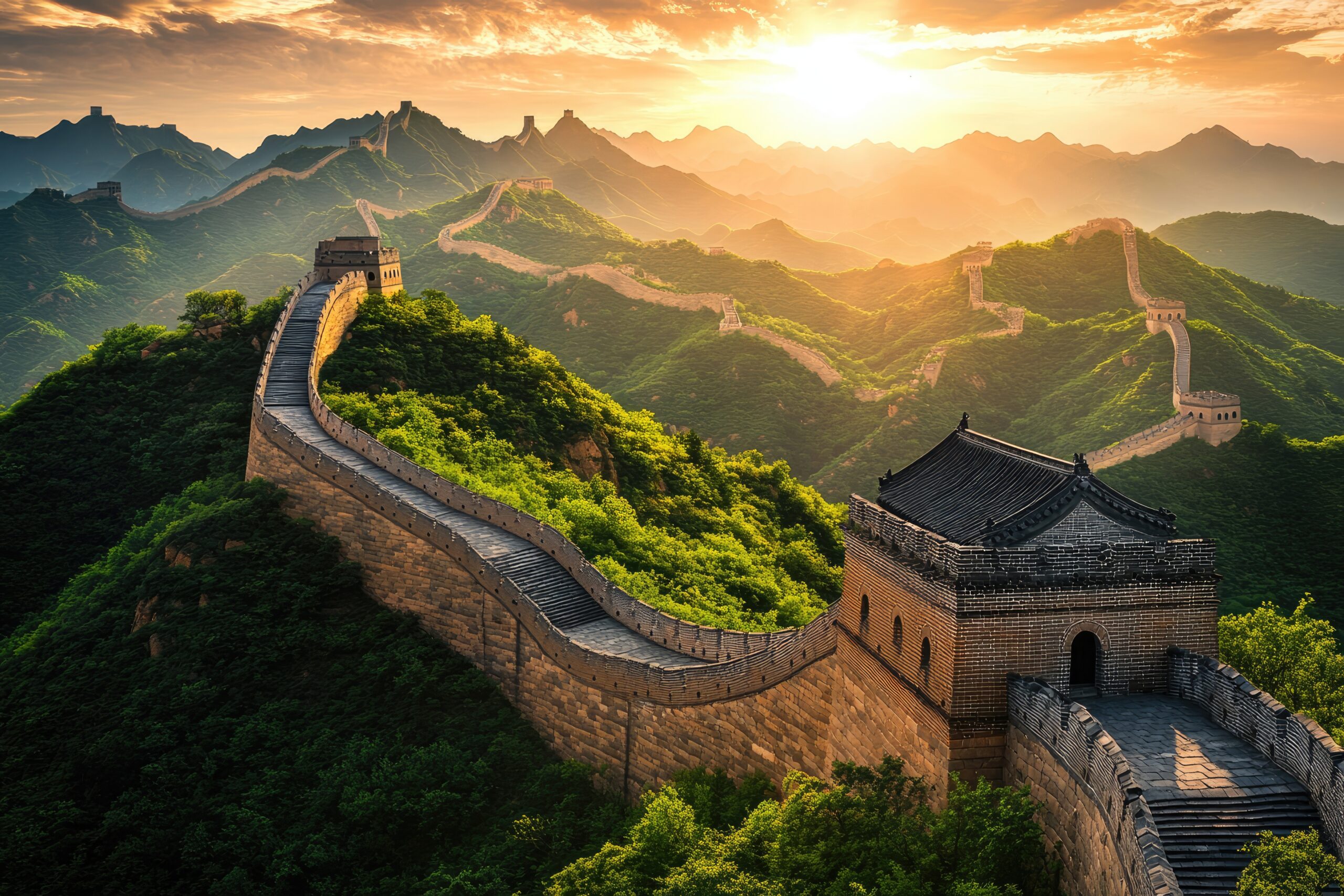
The Great Wall of China. This time I’m not here to swoon like a fanboy over its engineering mojo. I’m here to shoot a commercial. That means permits. Meetings. Smiles that hurt your face. Getting permission to point a camera at a pile of old rocks from a government that’s very good at saying no. By the time the paperwork is done, the production has cost me years off my life and, quite possibly, the blue-book value of a kidney. But here we are.
The drive out of Beijing is a slow escape from gravity. You pass the usual suspects: outlet malls, construction that already looks tired, beige apartment blocks cloning themselves to the horizon. Then the city loosens its grip. Billboards thin out. Mountains show up, big and silent, like the adults finally walking into the room. Somewhere out there, slapped onto a ridge with the confidence of a bad tattoo, is Mutianyu—one of the “nice” sections of the Wall. Nicely restored, nicely managed, nicely monetized. A historically accurate panic attack with a KFC grafted on to the entry.
Legend says the Great Wall was built to keep “them” out. Barbarians. Horsemen. The Mongols, the Xiongnu, anyone with a good pony and bad intentions. That’s the tour-guide story, the one that plays well over bus speakers. The reality is messier, meaner. This thing wasn’t one clean line drawn on a blank map. It was a long, drawn-out anxiety attack poured into stone over a couple thousand years. Each dynasty inherits the same paranoia and does what scared governments always do: builds more wall. More brick. More watchtowers. If it kept invaders out, great. If it also kept tax cheats, deserters, and disillusioned peasants in, even better.
You hear the stories: laborers dying on the job and getting rolled straight into the foundations. Why waste time on funerals when the wall itself can swallow you whole? It’s infrastructure as mass grave, public works as threat. Don’t run. Don’t complain. Don’t dream of the other side of the mountains. The wall is already waiting to take you in, one way or another.

Mutianyu is a cleaned-up version of that nightmare. The stone looks good on camera. The parapets stand at attention. Vendors know their exchange rates and the top five phrases every foreigner learns in Mandarin. You climb steep, uneven steps that were never designed for your “comfortable walking shoes.” Somewhere back in the Ming dynasty, some poor bastard in a quilted jacket did this every day with a bow on his shoulder and orders not to screw up. His life was boredom, cold, and the occasional panic. Boredom doesn’t sell anymore. Which is why, clinging to the side of the hill, there’s something new: the toboggan.
This is where it gets weird in a specifically, gonzo modern way. There is now a toboggan course running off the wall. Yeah, at first I thought it was a hoax to prank gweilo like me. too. But sure enough there’s a track snakes down the mountain in stainless steel, a shiny, unapologetic scar. You drop into a plastic sled with a single lever. That’s it. That’s your whole religion now. Push forward to go. Pull back to not die. Some kid in a fluorescent vest—underpaid, overqualified, and absolutely sick of people like you—barks the rules: no bumping, keep your distance, don’t be an idiot. Everyone nods, which guarantees at least three people will ignore everything he just said.
There is something deeply, gloriously wrong about launching yourself off the Great Wall in a little plastic coffin. Emperors bankrupted whole provinces to haul this stone into the sky, and now you’re riding their neurosis like a theme-park water slide. You rattle into the first curve and feel that little lizard-brain voice wake up: this could hurt. This could go badly. Somewhere beneath the concrete and mortar are the bones of men who never got to leave. You, on the other hand, will be back at the hotel bar by six, telling the story over cold Tsingtao and Wi‑Fi.
Up top, the myth sells itself easily. Lovers pose in doorways where archers once squinted into the distance. Influencers practice their faces, rehearsing a kind of portable, exportable spirituality: look at me, communing with history. Tour groups shuffle by under little flags, following a guide with a microphone and a schedule. Down on the sled, the myth is wearing a clown nose. The kid in the vest waves you on with the worn-out authority of every line cook, bartender, and traffic cop in the world: do what I say or this goes sideways fast. “No bumping!” he yells again, as if humans have ever been good at not crashing into each other.
Then you’re off. The Wall drops out of your peripheral vision. All that stone, all that history, disappears behind you as the track dives into the trees. The sound of plastic on steel is ugly and perfect. The curves come quicker than you think they will. Gravity, as always, is not messing around. For a few seconds, there’s no empire, no storyline, no production schedule, no shot list. There’s just you, a lever, and the awareness that if this thing hops the rail or the guy behind you forgets how braking works, you’ll be very famous on the internet for a very short time.
Here’s the thing: in that moment, you’re closer to the truth of this place than when you were solemnly photographing stones. The Wall was always about control and risk, about fear and the illusion of safety. You are putting your faith not in emperors or party slogans, but in welds, bolts, and whatever training manual the toboggan crew got handed on their first day. Ancient power wanted obedience. Modern tourism wants compliance and a decent photo package. The feeling in your gut is the same: trust the system, hope it holds.
The track coils through pockets of quiet where the trees briefly swallow the noise, then spits you into long, open stretches where temptation lives. You could slow down, be responsible, arrive at the bottom with your dignity intact. Or you could shove the lever forward and let the mountain decide, hoping whoever’s ahead of you shares your philosophy on life and braking distances. The wind slaps your face, adds a little sting, a little clarity. For those seconds, the Wall isn’t an icon on the money or a drone shot in a travel show. It’s a line someone drew between “us” and “them” that you’re now using as a playground.
The joke lands when you hit the bottom. The track eases into a platform lined with merch and monitors. Plastic helmets hang like trophies from another, sillier war. Staff move you along with the controlled impatience of people who have seen every variety of human fear and bravado. On the screens, your face is frozen mid‑grimace, mid‑scream, mid‑idiotic grin. You can buy the proof that you were briefly alive in a different way for the price of a decent bowl of noodles in town. Most people do.
History, we’re told, is something we’re supposed to respect from a distance, preferably behind a rope or a tasteful plaque. But this place always told a different story. The Wall was built on fear of what was out there—horsemen, raiders, chaos. It kept failing. New enemies came. New flags flew over the same stones. The one constant is the human tendency to believe that if we just build enough walls—literal, metaphorical, digital—we can keep the bad stuff out.
Now the bad stuff is us: jet‑lagged, sunburned, wearing quick‑dry fabric and arguing over fridge magnets. The barbarians at the gate pay in cash and leave five‑star reviews. The Wall doesn’t keep them out. It invites them in, then sells them a five‑minute ride down its spine. It shouldn’t work. It shouldn’t mean anything. Yet, somehow, it does.
The Great Wall toboggan is located at the Mutianyu section of the Great Wall near Beijing, and costs $14-15 to ride.
How Not to Die on the Great Wall of China
The toboggan at Mutianyu is fun but it’s basically a metal luge with a handbrake, not a Disney ride, so thinking about safety is smart. Here are five hacks to keep you alive.
1. Control your speed like it’s a car
Learn the lever before you launch: push forward to go, pull back to brake, and practice a couple gentle squeezes right after you start.
Keep it smooth—no panic slamming or on‑off jerking—so you don’t fishtail or surprise the rider behind you.
2. Leave real space between sleds
Treat it like traffic: stay well back from the rider ahead; local guides suggest at least 10–35 meters to avoid pile‑ups.
The most common accidents are rear‑end hits when someone ahead brakes suddenly and a faster rider plows into them.
3. Dress and pack like you might crash
Closed‑toe shoes, nothing loose flapping around, and secure your phone/camera so you’re not one‑handing the controls for a selfie.
If you’ve got a daypack, wear it snug on your back; strollers, big luggage, and bulky gear aren’t allowed and make control harder.
4. Match the ride to your body and nerves
Don’t do the toboggan if you’ve got serious heart issues, high blood pressure, limited upper‑body strength, or just hate speed and self‑braking rides—take the cable car down instead..
5. Read the mood: staff, weather, and track
If it’s wet, icy, or super windy, slow way down; operators sometimes shut the ride in bad weather for a reason.
Actually follow the posted rules and staff instructions—no stopping, no standing up, no sudden exits—and bail if the track looks overcrowded or chaotic.