
Spain’s Camino de Santiago might be the big kahuna of modern pilgrimages, but it is not alone. Out on the English borderlands, a two‑day wander along Hadrian’s Wall and down toward Hexham and Corbridge can scratch the same itch—history, blisters, wine, and a quiet, unnameable shift somewhere behind your ribs. For people who don’t speak fluent religion but still feel like they need to walk something out of their system, this kind of route makes a brutal, beautiful kind of sense.
Pilgrimage without the brochure
Camino de Santiago has gone fully mainstream: more than half a million people now collect their Compostela each year, piling into Santiago de Compostela in a mass of aching knees, hiking poles, and half‑finished spiritual crises. A lot of them will tell you they came for “spiritual reasons,” which can mean anything from talking to God to trying not to drink themselves to death after a divorce.
For the non‑religious, or the vaguely religious in that “raised something, now mostly tired” way, these walks become something else. A Camino, a saints’ way, a Roman wall—they’re just long, thin excuses to step out of your life for a while and see what’s left when the notifications stop and all you have to worry about is where to sleep and how bad your socks smell.
Hadrian’s Wall: a two‑day reset
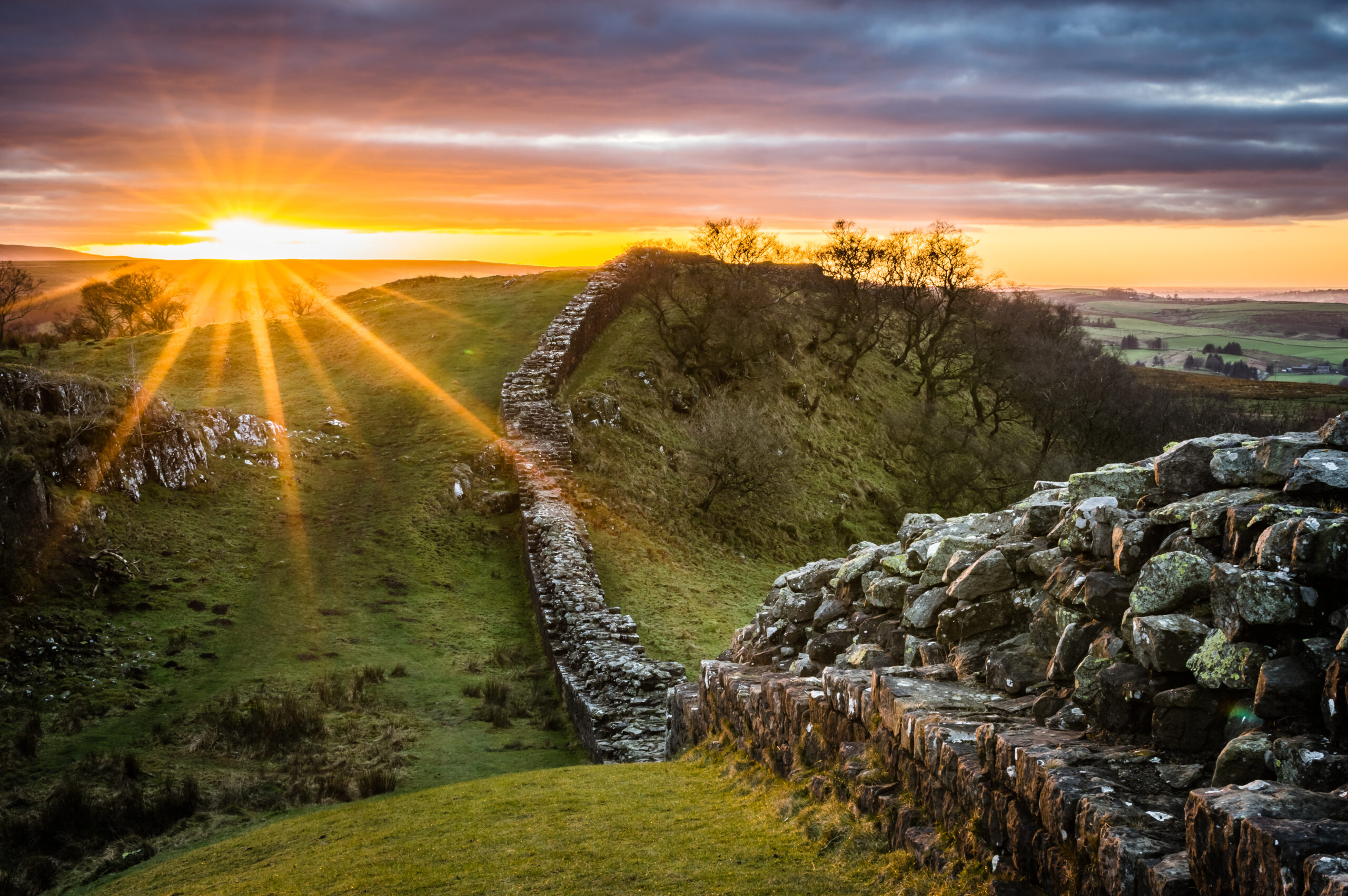
They call this stretch of Hadrian’s Wall a National Trail now, eighty‑odd miles of Roman stubbornness dragged from coast to coast, but “trail” doesn’t really cover it. It’s a line the Romans scratched across northern England that somehow never quite healed, an 84‑mile scar of stone and ditch and foundations that refuses to disappear. You’re not going to walk all of it in a weekend, but you don’t have to; the central section—Steel Rigg, Hotbank Crags, the high spine past Housesteads toward Chollerford—is where the wall finally admits what it is: drama.

It starts above Housesteads, where the air is knife‑clean and smells of grass, damp earth, and old stone. The fort lies below you—walls and gates and the ghost‑grid of streets—already filling with the first bright‑jacketed hikers doing their earnest museum faces. Somewhere down there a guide is talking cohorts and supply lines and the imperial everything of Rome, but you’re already pushing up to the ridge, leaving the explanations behind for the good part: the wall running the crags in long, looping curves, lakes shining in their hollows to the north, the fat green quilt of England rolling away to the south.
Guidebooks say this central section is “the best preserved,” which is like saying one bottle of Islay is “the smokiest” in a room where the whole bar is on fire. Steel Rigg, Hotbank Crags, Walltown—names you didn’t know a week ago that now feel carved into your calves. Up here the wall is still wall, chest‑high in places, shouldering its way over the whinstone sill like it still has a job to do, and you walk on the same line of stone laid by men who never imagined someone from your century would be tromping along taking selfies and thinking about their retirement plan.
The work your body remembers
The walking is work, but the good kind. Up a steep little pull that makes your thighs swear, down into a sheep‑chewed dip, over a stile that seems designed to test your hamstrings, past a milecastle where an information board tries to tell you everything you should be feeling. You stop more than once, partly because your legs insist, mostly because there are moments where the wall snakes away from you in a perfect curve—stone on stone, horizon layered on horizon—and it hits you: this was once fresh‑cut, militarized, alive with orders, boredom, woodsmoke, and fear.
Out here, “pilgrim” is just another word for “person who remembered they have a body and decided to use it for something other than sitting.” Your head, which came packed with emails, unpaid bills, and whatever fresh hell the news is pushing this week, slowly empties out and fills with simpler metrics: breath, heartbeat, the number of steps to the next rise, how far until beer.
You meet the usual suspects you find on these routes. A couple from Australia, sun‑tough and chatty, chasing Roman roads across Europe like other people chase Michelin stars, talking about Vindolanda’s writing tablets as if they’re reading dead cousins’ mail. A retired teacher from Newcastle doing this stretch for the third time because “it clears the head better than any doctor,” which is probably the most honest review any national health service is ever going to get. A local with a dog and a lifetime’s worth of names for every farm, hill, and lump of rock, half of which will never make it onto a map but all of which matter to him.
Coming down to the pubs and prayers
By evening you’re dropping toward Chollerford, into gentler land and softer light, the hard drama of the crags giving way to fields, hedges, and the occasional glimpse of the A69 reminding you that the modern world has not, in fact, disappeared. The wall slides away to find its own line without you, and you peel off toward the only holy site that matters at this hour: a proper pub. There is good beer, there is hot food, and there is that small, almost obscene pleasure of unlacing boots after a long day and feeling your feet bloom out into the air like two angry, liberated animals.
The talk at the bar is football, weather, “where’ve you walked from then?”, the usual liturgy of English small talk. Underneath it, something quieter: the knowledge that, for one day, your life was brutally simple—go this way, keep walking, try not to twist an ankle, find a bed. That simplicity feels like a luxury item in a world where you are expected to care about a thousand things at once, all the time.
Day two turns the dial from empire to religion—not in a chest‑beating, incense‑choking way, but in the soft, sideways manner of a country that’s been layering saints over stones and older gods for a long time. The path winds toward St Oswald’s Church at Heavenfield, a small, whitewashed church on a low rise that you could blow past without a second look if somebody hadn’t put it in the guide and drawn a neat circle around it. This is supposedly the site where a seventh‑century king planted a cross before defeating his enemies, kick‑starting a golden age of Northumbrian Christianity; these days it’s a tranquil little hilltop that still pulls pilgrims and hosts an annual procession from Hexham Abbey.
The gate into the field creaks like it’s on a movie set, the grass whispers around your boots, and the church door is usually open. Inside: cool air, stone, a faint hint of wax, and the kind of silence you don’t get in cities anymore. You sit for a minute—not because you have a list of things to discuss with God, but because it feels rude not to acknowledge a silence that old. It feels good to stop. It feels even better to stand up again and walk out, letting the door click shut behind you.
Hexham, Corbridge, and what really shifts
Hexham Abbey is where the history goes full cathedral: carved stone, stained glass, centuries stacked on centuries like plates in a dish pit, old prayers soaked into the walls. Medieval pilgrims came here from all directions; you’re just piggybacking on the last two days of a network that once spanned half of Britain. Outside, Hexham is all small‑city comforts: cafés, bakeries, the smell of decent coffee, the rewarding knowledge that you can now justify eating an indecent amount of cake.
The last miles to Corbridge are low‑key: fields, a slice of river, birds working the hedges, the background hum of traffic reminding you that your little retreat exists entirely inside a larger, louder world that did not pause while you were gone. Then the Roman town appears in its stone grids and foundations, this place where frontier once blurred into supply depot, trading center, and human mess. Officially, this is the end of the line for a lot of Hadrian’s Wall itineraries, which for once feels about right; some stories don’t need another chapter.
Two days. That’s all. Your legs know they’ve done work and are quietly proud about it. Your head feels like someone finally found the volume knob and turned it down a couple of notches. You have moved through open country and old stone, through chapels and abbeys where people have been hauling their hopes and fears for over a thousand years; you brought your own baggage, even if you never called it that.
Hadrian had the wall built to keep something out—Picts, chaos, the terrifying idea that Rome might not be the center of everything. Now it holds almost nothing but sky, wind, sheep, and the footsteps of people who, for reasons they might not be able to name without sounding ridiculous, need to spend a couple of days going forward through beautiful land. If that’s not pilgrimage, the word doesn’t mean a damn thing anymore.