
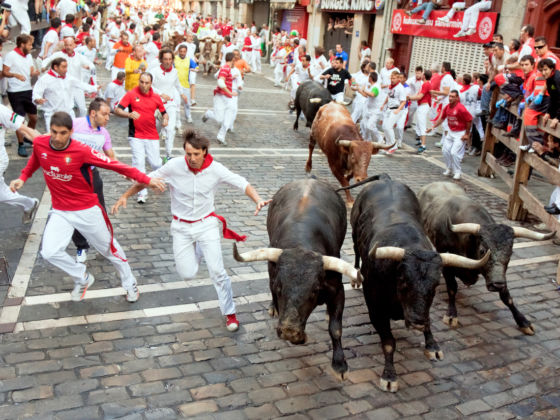
Every year, thousands of people—half thrill‑seekers, half lunatics—flock to Pamplona for the Encierro —the running of the bulls. It’s chaos wrapped in white cloth and red silk, a city drunk on adrenaline and Rioja before sunrise. The locals call it San Fermín, a tradition older than most nations, a religious celebration that over time mutated into a test of courage, idiocy, and something hard to name but impossible to ignore.
Hemingway wrote about it, romanticized it, made it myth. But the truth is grittier. The bulls don’t stroll through those cobbled streets for your entertainment—they charge. Six of them, guided by six oxen, pounding through medieval corridors slick with spilled sangria and fear. The run lasts just over two minutes, but those minutes stretch into eternity when there’s half a ton of Spanish muscle and horn thundering behind you.
People say it’s a “once in a lifetime” thing, an encounter with the raw machinery of being alive. For some locals, it’s family tradition—a way to honor Saint Fermín, to measure courage against the same streets their fathers ran. For everyone else, it’s a confrontation with mortality dressed up as tourism.
You wake up before dawn, still tasting last night’s cheap wine and bad decisions, and you start to question your sanity. Then the rockets fire, and it’s too late. Hooves detonate on the stones. You can smell the animal before you see it—the musk, the heat, the sheer power of it. And when death is sprinting just a few feet behind you, you discover something about yourself. It’s not pretty, but it’s honest.

If you make it to the bullring alive, you’re high in a way no drug can match—wired, unsteady, half laughing, half crying. You’ve just stared into the abyss and gotten away with it. Ordinary life afterward can feel pale, like a washed‑out photograph. The office, the deadlines, the neuroses—they shrink in the rearview mirror. You’ve already placed your chips on the table in Pamplona, and the dealer let you walk away.
For a week, the city becomes a madhouse of white and red, saints and sinners, drunks and dreamers, all running from something—literally or otherwise. It’s brutal, beautiful, and morally complicated. It’s everything life is when you stop pretending it’s safe.
Running with the bulls can change your life because it forces you into a naked, non‑negotiable confrontation with fear, mortality, and who you really are when there is nowhere to hide. For some, that short, stupidly dangerous sprint becomes a story they measure themselves against for the rest of their days.
You choose to step into real risk, not simulated danger, which tears away the everyday illusion that life is safe, controllable, and guaranteed.
In a few violent minutes, your nervous system is flooded with adrenaline and dopamine, etching every sound, smell, and decision into memory so sharply that those moments feel larger than entire months of “normal” life.
When you walk out on your own feet, the contrast between “I might die here” and “I’m still here” can permanently reset your sense of what matters and what is worth being afraid of.
Running becomes part of your personal mythology: a story you tell yourself about being the kind of person who showed up, didn’t flinch, and stayed on their feet in front of half‑ton animals built to kill.
High‑risk experiences light up the brain’s reward circuits: thrill‑seekers tend to get more dopamine and less cortisol from chaos, which reinforces the urge to chase experiences that make them feel vividly, almost painfully alive.
Running with the bulls is soaked in personal mythology: terror, euphoria, second guesses, and the kind of self‑revelation you only get when hooves are pounding the street behind you. That chemical high, coupled with relief and pride, is why people talk about being “hooked” after surviving a run, or say it “turned my life around” at a moment when they were lost.